The HobbitHouse Ilustrated Glossary of Woodworking terms

A    B    C    DE    F    GH    IJK    L    M    NO    P    QR    S    T    UVWXYZ   
To see general comments about this glossary and for the email address, click here: GLOSSARY


for images of wood itself, go here -> wood id site


T&T --- Through and Through

T / T --- Through and Through

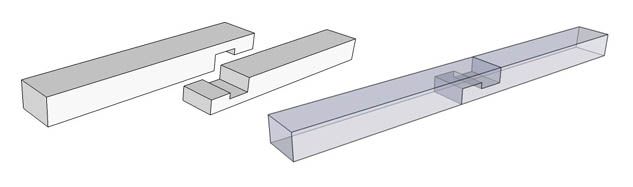
tabled scarf --- A scarf joint that has internal notching that greatly enhances the joint's resistance to forces that would tend to pull the two planks away from each other. Sort of like when you curl the fingers of each hand towards your palms and then lock them together, but best described by example, so here you go:


table saw --- A table mounted power saw where the blade rises up (by an adjustable amount) through a slot in the table (see table saw insert). The blade can be angled (see left tilt and right tilt) and wood can be passed over the blade at an angle, thus making it possible to do compound miter cuts. Some feel that this type of saw is less flexible than a radial arm saw but it can do one thing that the radial arm saw is not physically capable of and that is rip wide panels. This type of saw is by far more common than the radial arm saw. It ranges in size from a 7-inch blade on really small (benchtop) models, up to monster size at sawmills, but the "standard", to the extent that there is a standard, is one with a 10-inch blade; that's what most hobbyists have and even small businesses are often content with it but may go to a 12-inch blade. There are small models that fit on top of a bench instead of being full floor models, some have cabinets housing the motor and some run on 110 volts and some on 220 volts. The primary types and some of their leading characteristics are as follows. Click on any type name for more details.

type
wiring and
nominal power
housing and footprint
approximate
price range
weight
benchtop 110v, 1 to 1.5HP tiny cabinet, 3 to 4 sqft $75 to $600 ? lbs to ? lbs
contractor 110v, 1.5 to 2 HP open legs $250 to $1,000 ? lbs to ? lbs
hybrid 110v, 1.5 to 2 HP cabinet $500 to $2,000 ? lbs to ? lbs
cabinet 220v, 3 HP to 5 HP cabinet $1,000 to $5,000 ? lbs to ? lbs


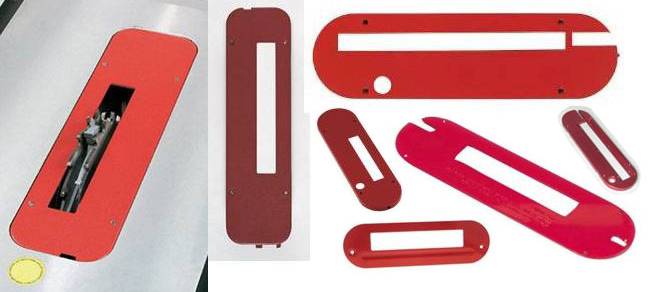
table saw insert --- The removable piece through which the blade projects on a table saw. The opening has to be large enough to allow for blade tilt (see left tilt but this means that it is large enough to allow small strips of wood and other things to slip past the blade and fall into the housing. This can be avoided during non-tilted operation by using a zero clearance insert. Examples:


tack --- (1)[verb] To fasten into position with a small metal fastener such as a tack (see noun definition below) or brad.
tack --- (2)[noun] The degree to which an adhesive or finishing agent is tacky.
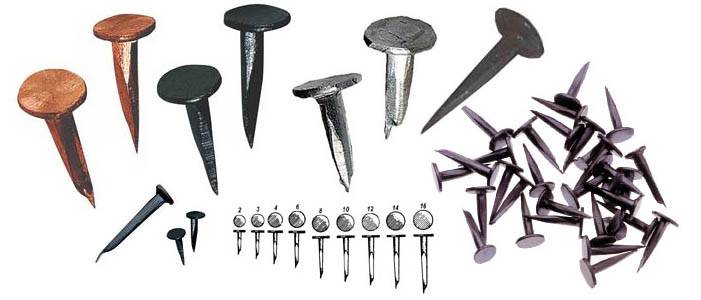
tack --- (3)[noun] A short, sharp-pointed nail, with a moderately broad head for its size, that is used for carpeting and upholstery. Tacks are usually made of of soft, non-rusting metals such as aluminum or copper and in any case the sharp point is deliberately thin and tends to curl when the tack is driven into wood thus providing extra holding power which is needed because tacks are so short. Although tacks are used for fastening cloth to wood, that function is more often performed with what are casually called "upholstery tacks" and more correctly upholstery nails. Examples:


tack cloth --- A fabric impregnated with a tacky substance that is used to remove dust from a surface. Often used to get a partially coated surfaced totally clean before adding another coat or to clean up a freshly sanded surface before applying a finishing agent.

tack free --- Describes the condition of a finishing agent or adhesive that has gone far enough into the curing process that it will no longer trap airborne dust or other contaminants (such as human or animal hair that happens to be wafting around on the breeze in your shop).

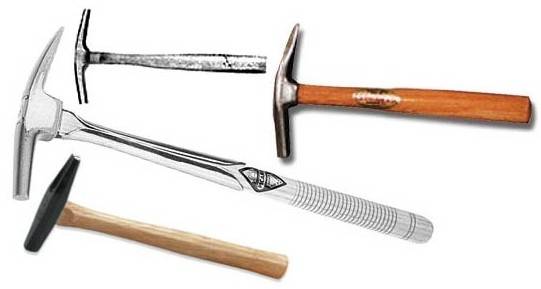
tack hammer --- A lightweight hammer used to drive tacks and upholstery nails, most commonly into furniture as part of the upholstering process and thus it is also called an "upholstery hammer". Examples:


tack rag --- synonymous with tack cloth

tack time --- The amount of time it takes for an adhesive to set up before it can form a bond. See also tack free.

tacky --- Highly viscous and sticky; the state of an adhesive or finishing agent after it has been applied but before it is totally cured. When a finishing agent is first applied, on to the time when it is still tacky, it is highly subject to the absorption of dust particles, so needs to be kept in a clean-air environment.

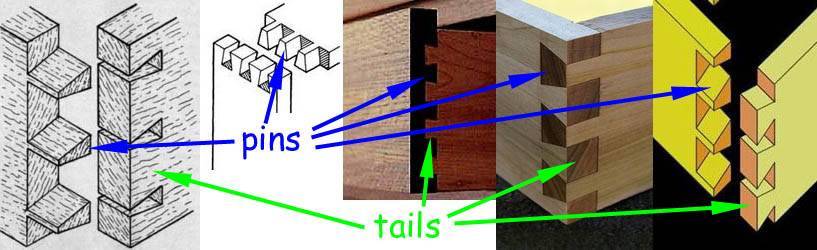
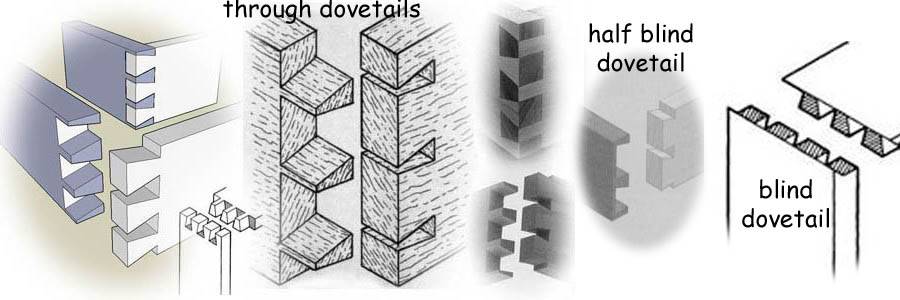
tail --- Half of the locking mechanism in a dovetail joint. A dovetail joint consists of flanged projections called tails on one plank and a set of corresponding recessed areas on the other plank, with the protruding sections between the recesses called pins. Although a dovetail joint has maximum strength when the pins and tails are the same size, aesthetic considerations often lead to the craftsman making the tails bigger than the pins. Examples:


tailstock --- On a lathe, this is the part that contains the stationary piece that holds the end of the workpiece which is being turned by a mechanism in the headstock. For face turnings, the tailstock is not used in any way. Illustrated at: wood lathe.

tanalised --- Describes pressure treated lumber that has been given a preservative pressure treatment, impregnating the wood with a highly toxic propriety blend of copper and arsenic. This process is only performed on softwood.

tang --- The tapered end of a chisel or file or other woodworking tool that is driven into a handle, or the extension of a knife blade that the handle is put around. Files and such usually just have a tang that is a rectangular cross section extension of the device and this is jammed into a hole in a wooden handle and remains in place by the pressure of the wood against the tang. Such pressure fits do come loose sometimes. For knives, the tang is more complex and there are two basic types, the "hidden", so named because it doesn't show on the handle and the "full", which becomes a stripe on both the upper and lower edges of the handle. With knives, the tang is usually riveted to the handle. Compare/contrast to socket. Examples:


tangential --- Tangent to. As regards woodworking, this term is used to describe one of the three primary planes or flat surfaces of a tree that are used to discuss a number of issues regarding wood. The three planes are the radial plane, the tangential plane, and the transverse plane. The tangential plane is any plane that is parallel to the axis of the tree, but does NOT pass through the axis but rather is further out into the trunk and is tangential to a growth ring. When talking about all three planes together, the tangential and radial planes are always considered to be perpendicular to each other, with the transverse plane perpendicular to both of them.

tangentially cut --- synonymous with flat cut

tangential shrinkage --- Reduction in size of a piece of lumber that occurs tangential to the growth rings, and is caused by drying the wood out either through air drying or kiln drying. Green lumber has so much moisture in it that it contracts in size when dried, and this contraction occurs differently in the three planes of the wood (radial, tangential, and longitudinal). The shrinkage is expressed as a percentage of the dimension of the wood when green. So, for example, if a flat cut plank were 20" wide when green and 19" wide coming out of the kiln, it would have a shrinkage of 5%, and because of the direction, this would be tangential shrinkage. Compare/contrast to radial and longitudinal shrinkage. Radial shrinkage is always less than tangential shrinkage, which is why quartersawn boards have less movement in service than flat cut boards. Longitudinal shrinkage is generally negligible, the other two are not.

tannin --- A complex chemical compound created naturally in some plants such as grapes. As far as woodworking is concerned it is of interest because some trees, most notably oaks, contain a fair amount of tannin and this makes them susceptable to an artificially induced darkening process called fuming.

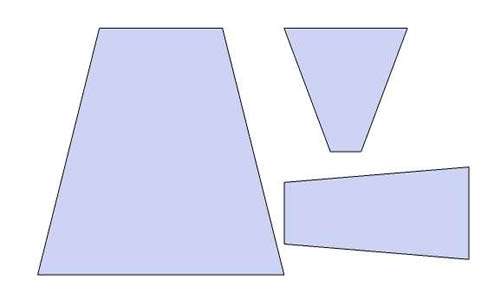
taper --- [noun] In woodworking, as in standard English, this refers to something that goes from wider to narrower. In addition to general use in describing tools and objects, it specifically means a wooden object such as a table leg that becomes smaller along its length.
taper --- [verb] To create a taper (see noun definition directly above).

taper cut --- A cut that creates an object that is tapered. Generally this refers to cutting a plank at an angle along its length so that it has one end narrower than the other.

tapered --- Describes an object such as a table leg that goes from one dimension to a smaller dimension as you move in one direction, generally along the length (but an object could be tapered along its width).

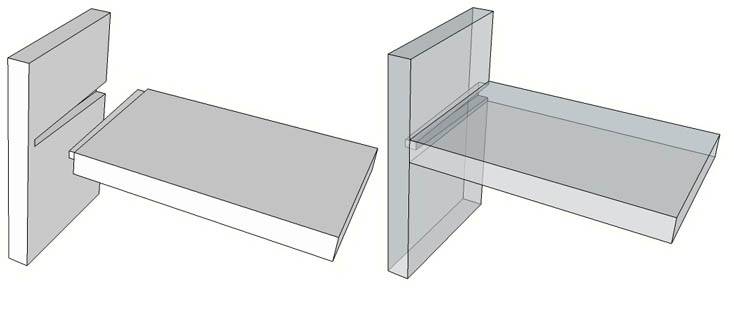
tapered dado --- This is a joint that can't quite make up its mind whether it is a dovetail joint or a dado joint. Rather than having a normal dado in the vertical piece, there is what looks like a single, highly elongated, dovetail slot, and a corresponding shape is cut into the end the horizontal member. This provides (when compared with a normal dado) much more resistance to a shelf, for example, being pulled out from the front, and in fact this could be used as a knockdown joint although with no glue or fasteners, there would be the danger of the side member bowing outwards and releasing the shelf or the horizontal member sagging downward and slipping out of the joint, so this is not terrific as a knockdown joint for long shelves in tall bookcases. Examples:


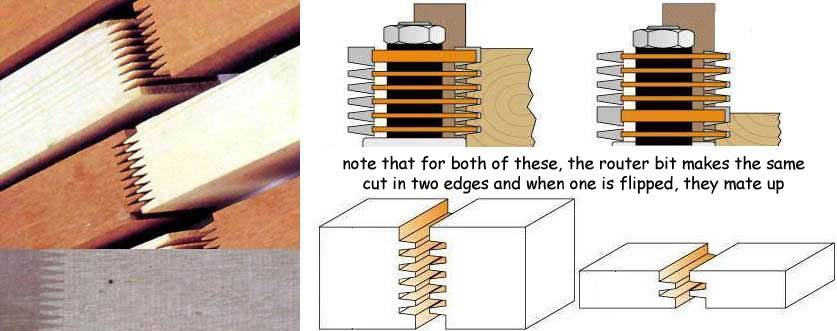
tapered finger joint --- A joint where narrow extensions of wood, resembling fingers, are cut in the ends of pieces of wood so that they interlock and form a joint. When the extensions are glued together, they form a very tightly bonded unit. This technique is often used to splice short lengths of molding to form much longer pieces. The fingers are sloped and may be cut parallel to either the wide or narrow face of the piece, but are normally cut parallel to the short face. Great variety can be found in the exact shape of the fingers. Examples:


tapered reamer --- Although this term is the correct name for one particular form out of a class of metal working tools called "reamers", woodworkers only use this particular form of the tool and they tend to call it a "reamer" rather than the correct term of "tapered reamer", so I have put the definition and illustrations under the term reamer.

tape time --- The drying time required for a finishing agent before it can be safely masked with tape for lettering or striping, such that the tape will not mar the surface.

taxonomy --- The science of classifying living organisms. The system currently used by taxonomists is called the Linnaean taxonomic system, after the Swedish biologist Carolus Linnaeus (1707 - 1778). This system breaks down organisms into seven major divisions, called taxa (singular: taxon), as follows:
There are many subdivisions of the seven main taxonomic levels, such as Subphylum, Subclass, Infraclass, and so on. You may see many of these other sublevel taxa listed in the taxonomic tree of an organism. At the lowest (most specific) level in the formal tree, a species is one group of genetically distinct, interbreeding organisms. The average genetic differences within a species are less than the average differences between that species and any other closely related group of organisms. Below the level of species, there are "subspecies", "variety", and "form". The classifications also tell something about the degree of relation between different organisms. For example, two animals or plants that belong to the same family and genus are more closely related than two that simply belong to the same family but different genera.

This tree of terminology (kingdom down to species) causes one point of confusion in that the lowest level of categorization is the species but the name of a species is normally given as a two-word pair, the genus and the specific epithet. Because the nomenclature tree says the categories are genus followed by species, it is natural to assume that the second word in the pair is the species, but that is not correct. Species is the 2-word pair of genus and specific epithet. So for example, the species name for East Indian rosewood is Dalbergia latifolia with Dalbergia being the genus and latifolia being the specific epithet. Also note that species is both singular and plural in taxonomy. The word specie has to do with money, not plants.

When giving a species name, the genus should be capitalized and the specific epithet should not be capitalized and both should be in italics when mechanically printed, and on a computer, or underlined if hand-written. The family and above do not require any special printing type, but ARE normally capitalized.

T beam --- A beam resembling a "T" in cross section, so like an I beam with the bottom flange missing. Several side-by-side T beams acting as a unit may form a floor substrate.

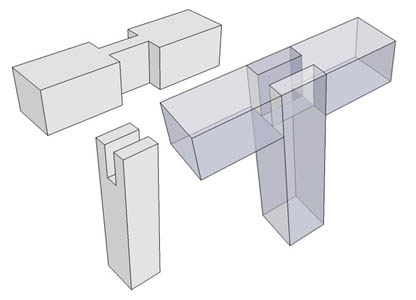
T bridle joint --- A bridle joint in which the cross piece has dado cuts in both sides and what remains fits into a groove cut in the top of the mating piece, forming a shape like the letter "T". This joint can be pinned with a dowel through the middle and if desired, the dowel can be stubbed short of the front face. Example:


tear --- The action of crushing, instead of slicing, wood grain on the surface of a plank in a surface planer. Tear is frequently caused by irregular grain, interlocked grain, or a situation where the grain points up into the cutters instead of down and away from them. A similar condition caused by cutting edges such as chisels is called lift.

tear out --- [also tearout] Broken or torn fibers that occur as the blade of a tool exits a cut, usually during a cross cut operation. It also can occur in lathe turnings if the lathe tool is not sharp enough or is fed too aggressively. Also see chip out.

teeth --- The cutting tips of a saw blade, rasp, forstner bit, or other woodworking tool. See also, tooth.

telegraphing --- Revealing the contour of an underlaying material when the overlaying material is weak. For example, a weak or thin finishing agent might telegraph any flaws or grain irregularities such as some types of knots, a layer of shingles put down over an existing layer might show buckling if the underlayer does, and veneer laid down over a joint might telegraph the contour of the joint.

temper --- The degree to which steel has been treated with, and retails the results of the treatment, by repeatedly heating and cooling it. This contributes to its flexibility/brittleness) and ability to retain an edge. When steel in a tool looses its temper, that's a bad thing.

temperate --- As regards wood, this refers to climate, specifically meaning a climate that has varying seasons, with a relatively long warm summer and a relatively short cold winter. The temperate zones of the world are, technically speaking, from 30 degrees latitude to 60 degrees latitude in both hemispheres. Below that is the tropics and above it is the polar regions. HOWEVER, there are some portions of the tropics that have temperate climates, so you can't entirely rely on geography to tell you if a wood has grown in a temperate climate. Trees that grow in temperate climates have growth rings where as trees that grow in those tropical climates that have a wet growing season year-round tend to not have growth rings, but trees that grow in tropical zones that have at least a somewhat temperate climate do have growth rings, though likely somewhat weak ones.

tempered --- Specifically this refers to steel made hard by tempering, but generically, it is used to refer any material that has been hardened by heat (and sometimes other) treatment.

tempered hardboard --- Dense hardboard that has been specially treated to increase its durability, strength, density, and moisture resistance.

tempering --- Specifically, this is a process of bringing steel to a desired hardness by repeated heating and cooling. More generically, the term is used to describe any process (usually heat, but could be chemical) that produces a hardened product.

template --- A pattern to guide the marking or cutting of a shape and is used either for repeated markings or cuts or to assure very precise cuts. One might create a template from something that is fairly easy to work, such as a relatively thin sheet of hardboard, and then use that as a guide to cut the same shape in something more difficult such as an oak plank. Very often used to guide router bits through a workpiece where the router bits, called piloted bits, have a non-cutting surface or roller bearing that rides on the template while the cutting edge goes through the workpiece.

ten mil veneer --- [usually written as "10 mill", not "ten mil"] A veneer sheet of any species and of any thickness bonded to a paper backing that is 10 thousandths of an inch thick. The paper backing increases the veneer's ability to bend without breaking, and also prevents splitting along the grain and the formation of bubbles (raised areas) after bonding to a substrate.

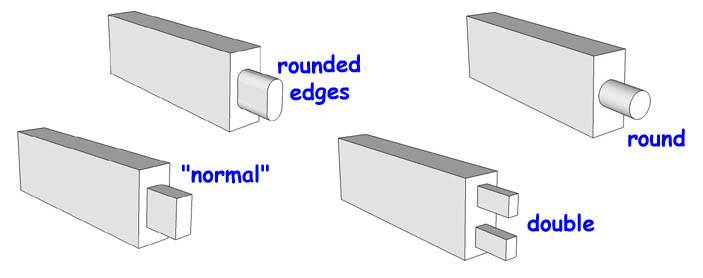
tenon - A projection on the end of a piece of wood for insertion into a mortise to form a mortise and tenon joint. Examples:


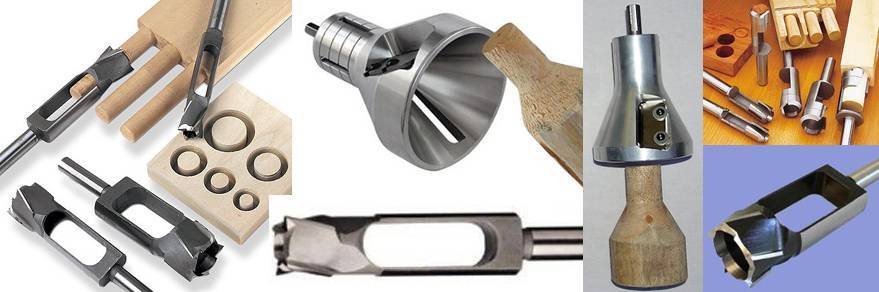
tenon cutter --- A type of power drill bit specifically made for cutting tenons. There are two basic types, the first for cutting flat-bottom tenons (or short dowel pins or plugs, if you want) and the other specifically for cutting rustic chair tenons with a tapered shoulder countersinking. The first type is normally used on planks and the second type is normally used on round stock. There is a short version of the first type that is specifically for cutting plugs, called, appropriately enough, a plug cutter. Examples:


tensile strength --- Resistance to tensile stress. Tensile strength parallel to the grain is resistance of wood to forces acting along the grain and tending to stretch the wood in length, whereas tensile strength perpendicular to the grain is resistance of wood to forces acting across the grain in the direction that tends to split a member, not stretch it. Compare/contrast to compressive strength.

tensile stress --- The tension force (force acting on a body which tends to increase its dimension, or volume) divided by the cross sectional area of the body upon which the load is applied. Tensile stress in wood can be lateral (across the grain), which tends to split the wood, or longitudinal (along the grain), which tends to stretch it. Wood has more longitudinal strength than lateral strength. See stress for further discussion.

tension --- A state or condition of being pulled or stretched by a force. Compare/contrast to compression

tension wood --- A type of reaction wood that most typically forms in hardwood trees on the upper side of a bent tree. It is called tension wood because it is literally in tension and it pulls the affected trunk or branch upward. Tension wood shrinks along the grain considerably more than normal wood, making it more prone to drying defects such as warping and also it is prone to fuzzy surfaces when planed because the fibers in tension wood are more jammed together than in normal wood. Tension wood is higher in cellulose and lower in lignin than normal wood. In my own limited experience, I have found that red oak tension wood is much stronger than normal wood; in fact one piece I had was literally stronger than nails, with 6d nails readily bending rather than sinking into the wood. Compare/contrast to compression wood which is the other form of reaction wood.

texture --- A wood characteristic determined by the size and quality of the wood elements, mainly the pores, and that basically describes the smoothness and uniformity of the surface. Descriptive terms include "smoothness" terms such as fine, medium, and course plus "uniformity" terms such as uniform, even, and uneven.

textured plywood --- Plywood panels with a variety of machined surface textures. Available in exterior type with fully waterproof glueline for siding and other outdoor uses and for interior wall paneling.

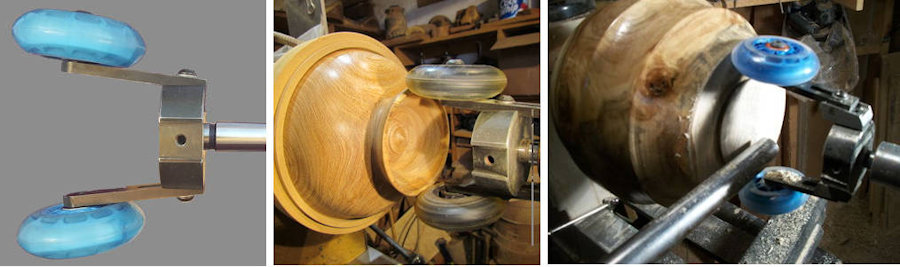
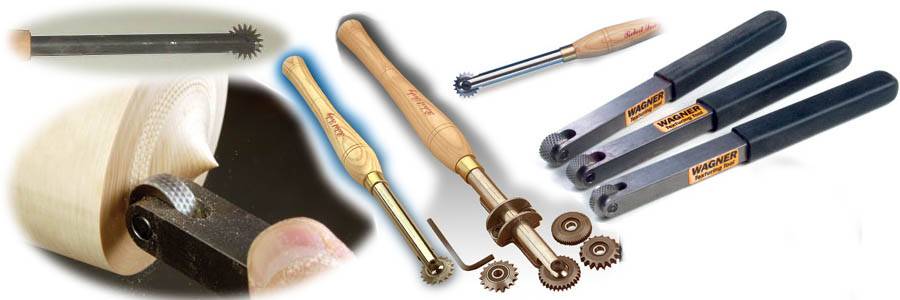
texturing tool --- A lathe tool; a ridged metal wheel that is pressed against a rotating object on a lathe and which then produces a grooved decoration in the object. These can be used with both face turnings and spindle turnings. Very skinny versions are often called "spiraling tools". Examples:


T full lap --- synonymous with through full lap (NOT because the "T" stands for "Through" but rather because the "T" represents the SHAPE of the joint)

T half lap --- synonymous with through half lap (NOT because the "T" stands for "Through" but rather because the "T" represents the SHAPE of the joint)

thermoplastic --- Describes material (e.g. wood resin) that can be resoftened with heat.

thermosetting --- Describes an adhesive or finishing agent that cannot be resoftened with heat once it has set hard.

thickness planer --- see planer

thin kerf --- Refers to a saw blade with a reduced kerf, typically used on expensive wood so that as little material as possible will be removed by the blade, and also used in resawing for the same reason. A normal 10" diameter circular saw blade has about a 1/8" thick kerf on a 3/32" thick body but a corresponding thin kerf blade will have about a 3/32" kerf on a 1/16" body, a reduction in kerf width of 25%.

thinner --- (1) A substance, usually a solvent used to dillute and decrease the viscosity of a finishing agent (usually paint, varnish, shellac, or lacquer) to make it easier to spread and/or to create a more even coating.
thinner --- (2) The volatile portion of a finishing agent; the thinner evaporates after the application of the finishing agent, which then hardens.

thinning --- The process of removing excess and poorer quality trees from a stand to allow the remaining trees adequate sunlight, nutrients and moisture so that they will grow at an even rate. This increases the value of the stand by providing more uniform growth.

thin wood --- [also thinwood] Wood for craft projects, generally from 1/8" thick to 1/2" thick. Also used for the backs of musical instruments. Priced by the square foot, not by the board foot. See lumber sizes for other "sizes" of lumber. Sometimes called "craft wood".

thousand board feet --- One thousand board feet. You will see this abbreviated as MBF ("M" is the Roman numeral for 1000). Logs, and lumber at wholesale, are measured by MBF. It is determined by one of three major scaling rules: Scribner, Doyle, or International Rule. When logs are scaled to determine their MBF, it is an estimate only. The actual board feet yield depends on how the sawmill cuts the log. It is possible for a log to produce more board feet than was estimated, thus producing an overrun.

thread --- (1) The helical-spiral projections around the shaft of a screw. Technically, the thread is a helical inclined plane and makes screws one of the six simple machines defined by classical mechanics.
thread --- (2) A very fine string, used to sew cloth items.

threaded --- Having threads

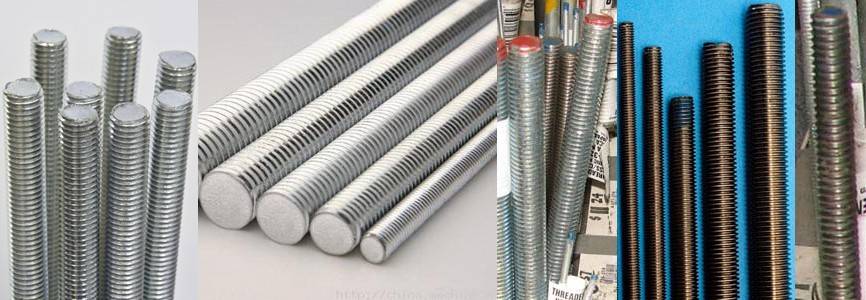
threaded rod --- steel or other metal rod that has been threaded for its entire length. Commonly available in hardware stores in sizes from about 1/8" to 1" in diameter and 3 feet or 4 feet long, threaded rod can be used to make custom-length fasteners and can also be used with turnbuckles. Examples:


threatened species --- A species or subspecies whose population is so small or is declining so rapidly that it may become endangered in all or a significant portion of its range. Includes items that have a conservation status of "endangered" or "vulnerable".

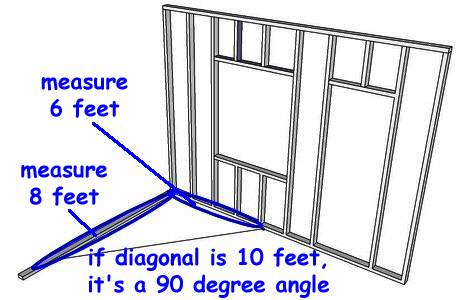
three four five --- Shorthand reminder for the fact that a triangle with sides of 3 units, 4 units, and 5 units is a right triangle. This fact is very useful for checking the squareness of items, such as house framing, where a normal square is not sufficiently large. Multiples of 3-4-5 work as well, so for example, a measurement of 6'x8'x10' will show a right angle. Example:


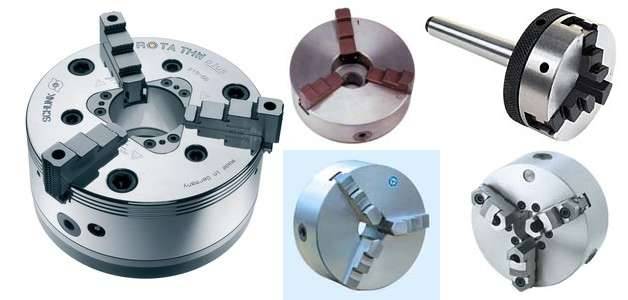
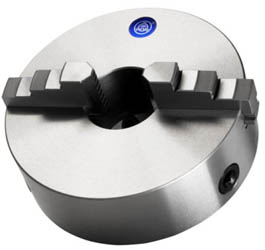
three jaw chuck --- A very common, versatile, chuck for a wood lathe that has (surprise, surprise) 3 jaws, but with less variety of jaw type than is found in four jaw chucks. The most common use for this chuck is to grab a raised rim on the bottom of a bowl, on the inside by expansion or on the outside by compression. When the jaws are grab by compression, the chuck is sometimes called a "compression chuck", and when the jaws grab by expansion, the chuck is sometimes called an "expansion chuck". The compression/expansion force is applied via a key, and the chuck may be a self centering chuck (i.e. a scroll chuck) or an independent jaw chuck. Examples:


three phase --- An electrical distribution system using three separate current carrying wires with the phases of each shifted by 120 degrees from each other. This has the advantage over single phase systems that the three phases can be used to create a revolving magnetic field to start large motors, and the added advantage that high current loads are distributed over 3 wires instead of just one, so it's used in industrial applications for large motors, but isn't needed in home and small shop applications.

three way corner miter joint --- same as triple miter joint

three way lap joint --- A crossed lap joint but with three planks all crossing at one point instead of the normal two. The way to cut such a joint is shown in the example below:

need to add three way lap joint pics


three way miter joint --- see triple miter joint

throat --- (1) The slot on the sole of a plane or spokeshave where the blade protrudes and through which shavings are ejected.
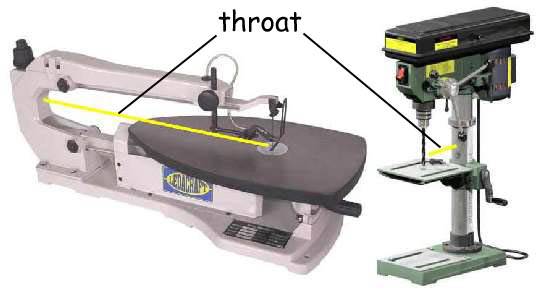
throat --- (2) A dimension that is a limiting factor in the size of a workpiece that can be accommodated by a tool. As examples, the throat of a scroll saw is the distance from the blade to the part of the rear frame that is closest to the blade, and the throat of a drill press is the distance from the point where the drill bit hits the workpiece to the closest point on the support column and the throat of a bar clamp is the distance from the center of the jaw to the bar. This throat size is the size you normally see associated with some tools. For example, when someone talks about a 16" bandsaw, the 16" is the throat size. Note, however, that on a lathe, the distance from the centerline of the headstock down to the bed is NOT referred to as the throat, and in fact the dimension that is always specified on a lathe is TWICE what it would be if it were specified the same way that throat is. On a lathe, the manufacturers use twice what would be the throat distance and they call that double distance the swing. On a clamp, the throat is NOT the specified size, but rather the maximum length of opening between jaws is the number used. Examples:


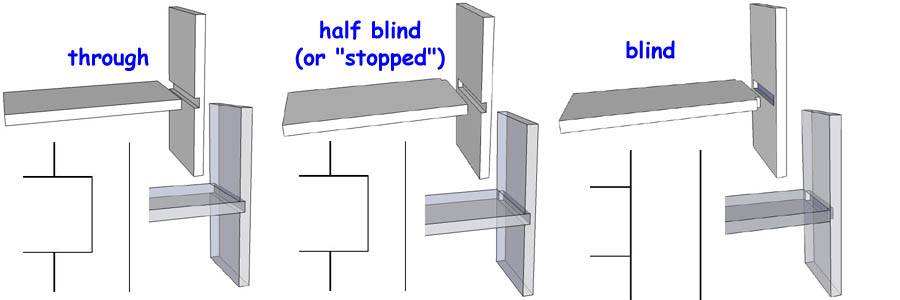
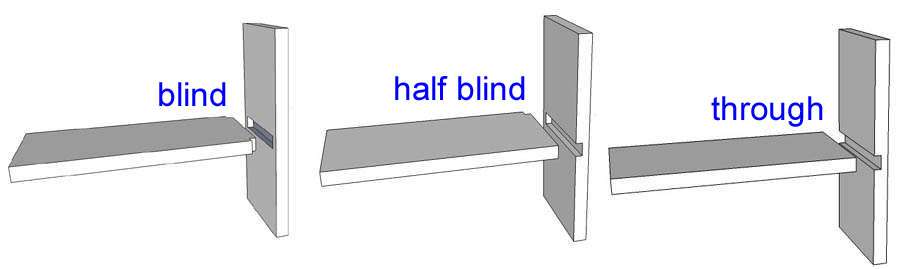
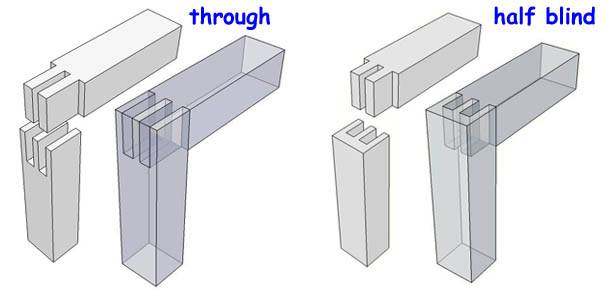
through --- Refers to a joint where the construction technique of the joint is as open to view as it can be, which generally means that part of the joint construction shows up clearly on an edge or a face (or both) of the adjoining pieces. Refer to the term joint for a list of joints that have a "through" variation. Compare/contrast to blind and half blind.

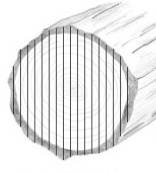
through and through --- a log cutting technique in which the entire log is simply cut in a series of parallel slices. A log sawn this way will produce a very few quartersawn boards (as it cuts right through, or very near, the pith) and the rest will be flat cut boards. This is often abbreviated to T&T, or T/T. There is a pic of a T&T cut log stacked with stickers, with the term sticker. T&T cutting is one of the most efficient ways of cutting logs - quarter cutting has a slightly higher yield, but quarter cutting is considerably more work because the log quarters have to be repositioned after each cut. Also, through and through cutting produces wider logs on average than any other cutting technique. Here's a drawing of a through and through cut log:


through angled dovetailed full lap --- see angled dovetailed full lap.

through angled dovetailed half lap --- see angled dovetailed half lap.

through angled full lap --- see angled full lap.

through angled half lap --- see angled half lap.

through angled keyed dovetail full lap --- see angled keyed dovetail full lap.

through angled keyed dovetail half lap --- see angled keyed dovetail half lap.

through bridle joint --- see bridle joint

through check --- A check that occurs on the wood surface as a drying defect and extends all the way through the plank to the other side. If a check does not go all the way through a plank, it is not called a through check but rather is called a surface check. If a through check causes a split at the end of a board, it is called a end check

through corner full lap --- see corner full lap

through corner half lap --- see corner half lap

through dado joint --- A dado joint where the dado cut goes all the way from one edge of the surface to the other, including both across the grain and along the grain. If the cut is along the grain, there is another more specific name, and that is plough. Compare/contrast to half blind dado and blind dado. Examples:


through dovetail joint --- A dovetail joint where the pins and tails of the dovetail joint go through both sides of the mating pieces. Compare/contrast to half blind dovetail and blind dovetail. Examples:


through dovetail bridle joint --- see dovetail bridle joint

through dovetailed full lap --- see dovetailed full lap

through dovetailed half lap --- see dovetailed half lap

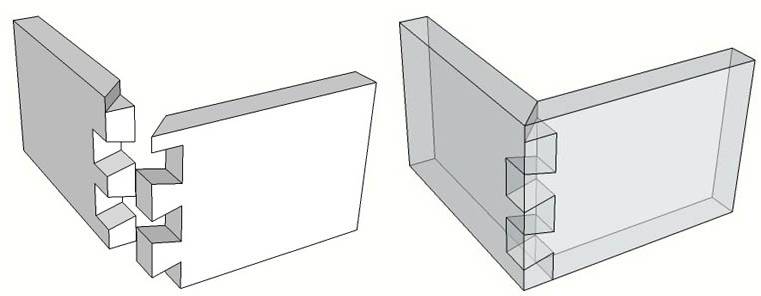
through dovetail with mitered shoulder --- This is a standard through dovetail except that the top section is mitered. Why anyone would want to bother with this I'm not sure, but I assume it's just because some folks prefer the mitered look at the top rather than the rabbeted look. Examples:

need to add through dovetail with mitered shoulder pics


through edge full lap--- see edge full lap

through edge half lap--- see edge half lap

through edge rabbet --- see edge rabbet joint

through end rabbet --- see end rabbet joint

through full lap --- see full lap joint

through half lap --- see half lap joint

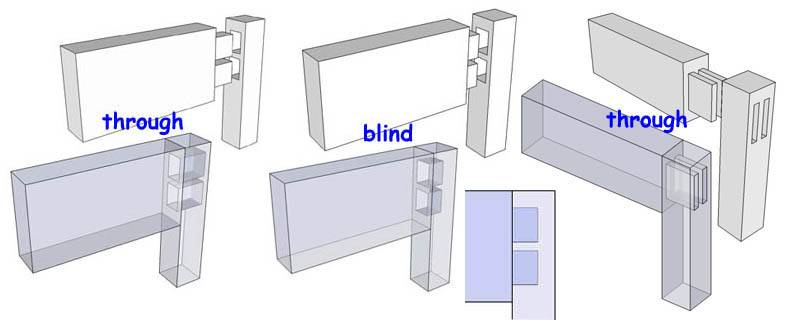
through joint --- a joint, such as a dovetail or mortise and tenon, in which one piece goes completely through the other or has obvious edges on the other piece. Compare/contrast to blind joint and half blind joint. The examples below show through and blind mortise and tenon joints and through and blind dado joints:


through keyed dovetail full lap --- see keyed dovetail full lap

through keyed dovetail half lap --- see keyed dovetail half lap

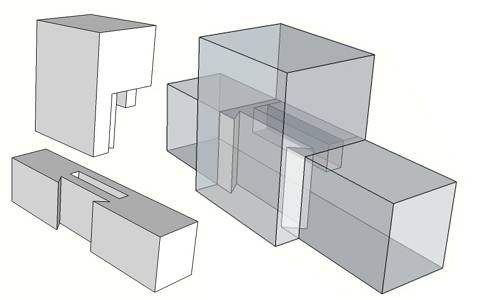
through keyed dovetail half lap with tenon --- A fairly complex joint that is a combination of through keyed dovetail half lap joint and a mortise and tenon joint. Although the drawing below shows the left face of the vertical piece extending out beyond the surface of the cross piece, that's just because it was shown that way in the book that I found it in; that is not a necessary characteristic of the joint. Example:


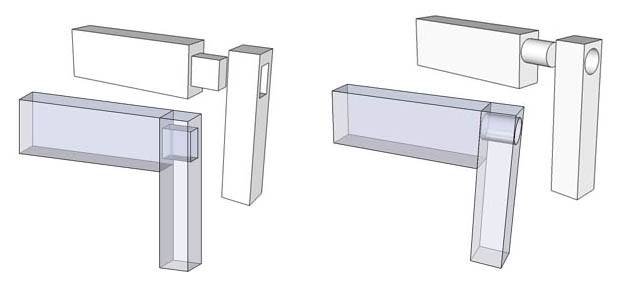
through mortise and tenon --- A mortise and tenon joint in which the mortise goes all the way through and the tenon is visible on the mating face. Compare/contrast to blind mortise and tenon. Examples:


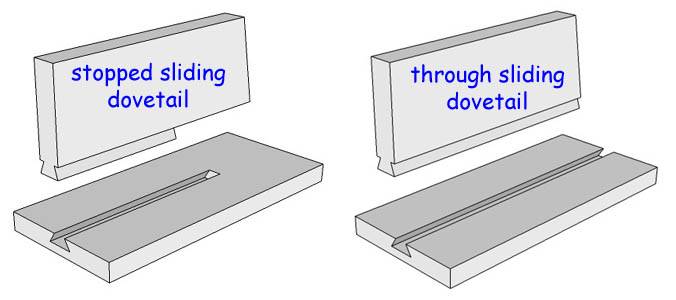
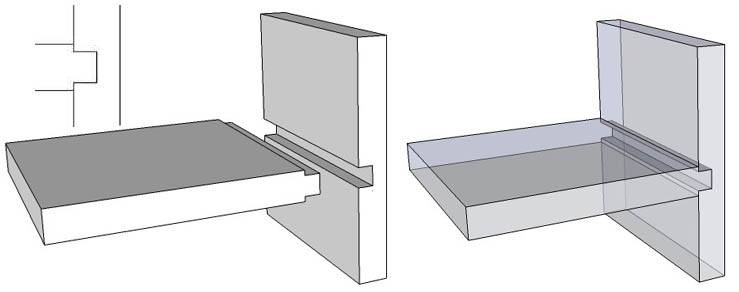
through sliding dovetail --- A sliding dovetail joint where the groove does go all the way through. Compare/contrast to half blind sliding dovetail. Example:


through twin bridle joint --- see twin bridle joint

throw back --- A logging term referring to portions of trees or limbs propelled back toward the feller by the action of a tree falling through other standing trees. This is not a good thing.

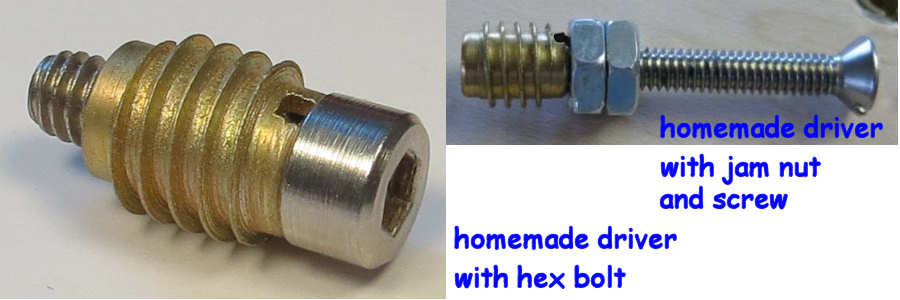
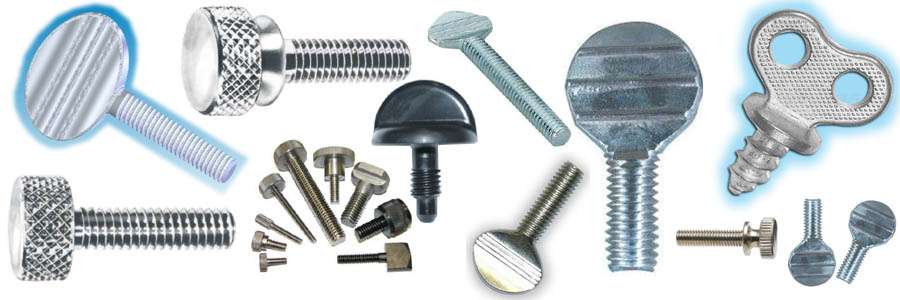
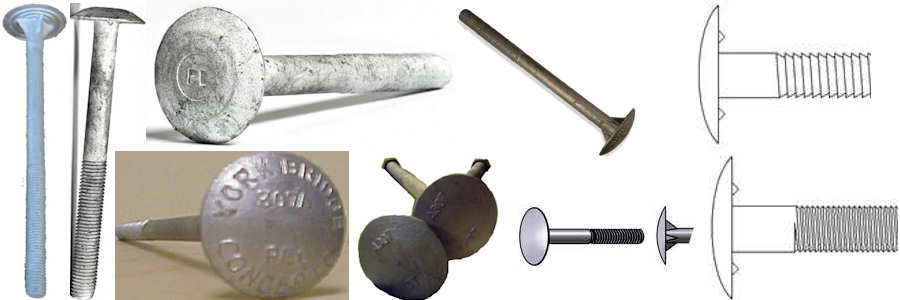
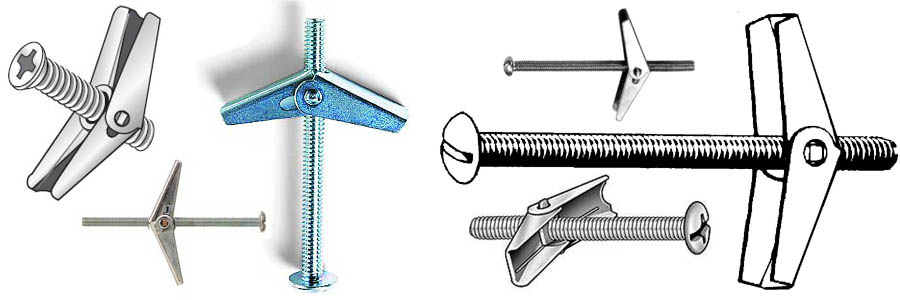
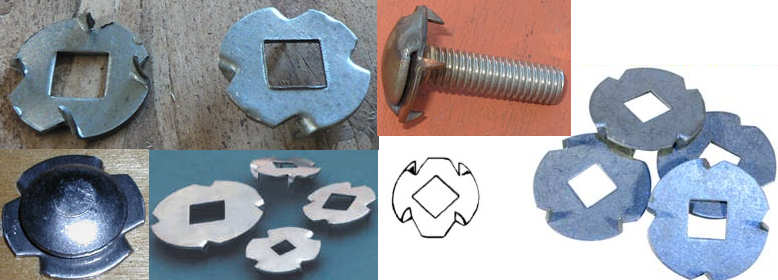
thrumbscrew --- This term is loosely used to describe any bolt (not screw) that has a knurled knob that is intended to be tightened with the thumb and first finger but it very specifically applies to a bolt (again, not a screw) that has a flat oval top that clearly is designed for use the the thumb and first finger. Examples:


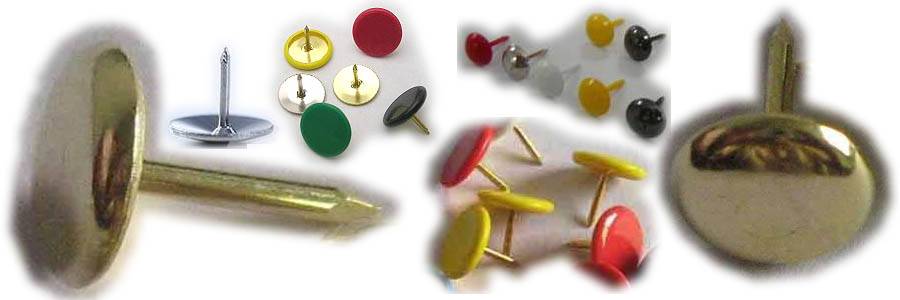
thumb tack --- The predecessor to the modern push pin, this is a short nail with a very broad flat head, used mainly to affix papers to a corkboard. Examples:


ticketer --- synonymous with cabinet scraper burnishing tool. NOTE: I have this from only one source and thus do not consider it reliable.

tie --- A structural member that resists tension forces. See, for example, collar tie.

tie coat --- synonymous with barrier coat

tiger --- This term is sometimes used, particularly with maple, to denote curly figure but is also a loose term sometimes added to the name of a wood that has a striped figure. Goncalo alves, for example, has "tiger wood" as one of its common names because it sometimes does have a figure, do to colored streaks, somewhat like that of the stripes on a tiger.

tight --- In addition to the normal English language meaning of strongly connected or strong joined, in wood working this term has a different meaning regarding veneer, where there is a complex interaction in the cutting process that results in veneer sheets having a "tight" side and a "loose" side. This is discussed in this glossary with the term loose.

tight cooperage --- Cooperage used as containers for liquids, semi-solids, and heavy solids. Staves are well fitted and held tightly with cooperage-grade steel hoops. Compare/contrast to slack cooperage.

tight grained --- synonymous with close grained

tight knot --- A knot that is so fixed by growth or position that it will firmly retain its place in the piece. That is, a tight knot is either intergrown or it is mechanically wedged so firmly in place that it will not move. The opposite of loose. There is no implication in the term tight as to whether the knot is sound or unsound although some references do seem to believe, mistakenly, that there is such an implication (they think tight knots are necessarily sound). Knot that are believed to be tight may in fact prove NOT to be tight if they are not intergrown.

timber --- Technically, the term timber refers to standing trees, but in North America, the term is generally used synonymously with lumber which includes felled, stripped, trees and even partially processed tree wood, although in such use timber normally carries the connotation of large, like a beam. So in North America, it would not be unusual to speak of bridge timber, meaning large structural members, but even in North America it would be odd to speak of a sawn plank as timber rather than lumber.

timbers --- This is a specific term that is different that the term timber and is not the plural of that term. Specifically, it refers to lumber that is at least 5 inches in its smallest dimensions (smallest side for a beam or diameter if cylindrical). Timbers are used as beams, posts, etc.

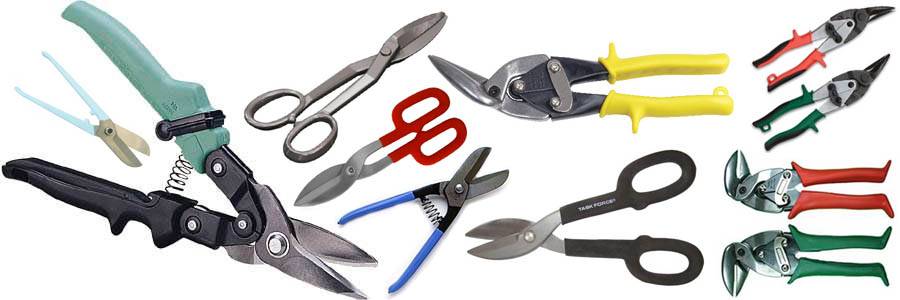
tin snips --- A type of shears specifically designed to cut (with a shearing action) thin sheets of metal. Examples:


tint --- see color terms

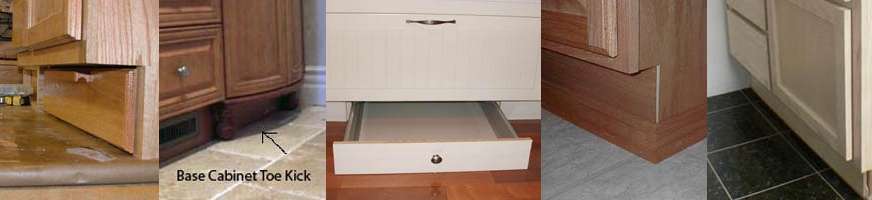
toe kick --- An indentation built into the bottom of a cabinet to provide room to allow the user to stand closer to the countertop; a place for your toes in front of a counter, the absence of which would cause your toes to kick the bottom of the counter if you stood too close. Sometimes the area is made extra high and a recessed drawer is added. Examples:


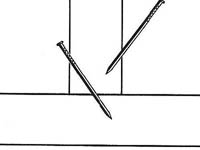
toenailing --- driving nails at an angle from one framing member that is butted up against another at a right angle, most often through a vertical stud into a base stud as shown in the drawing below (in which the nails are not yet driven all the way in). The term can also describe the use of screws for the same purpose. Compare/contrast to face nailing.


toenail joint --- see toenailing

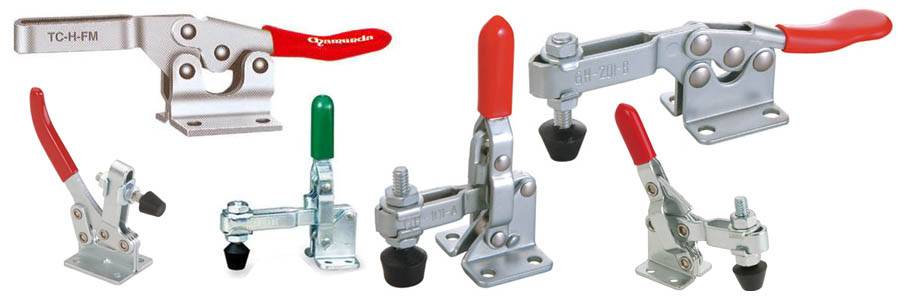
toggle clamp --- A type of clamp that uses a pivot and lever "on/off" action and limited range. It is mounted to the top of a bench and uses the bench as one of its jaws. It is also sometimes called a hold down clamp although that term more often is used with a different type of bench clamp. Examples:


tongue --- A word with many specific applications in various industries, all derived from similarities of various tool elements to the human tongue:
tongue --- (1) A projection of wood, such as that in a tongue and groove joint.
tongue --- (2) The shorted and narrower leg of a steel square.

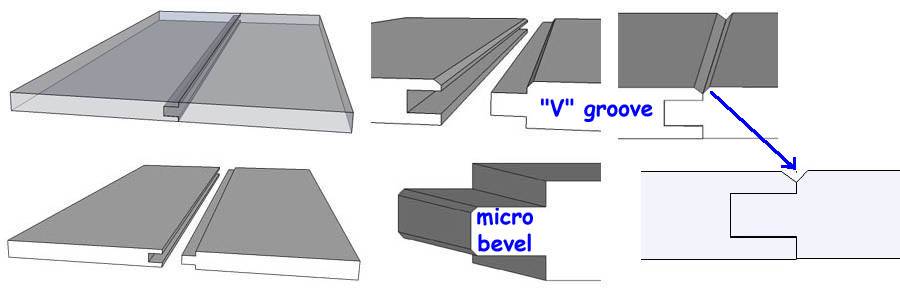
tongue and groove --- A joint where a projection (the tongue) along the edge of one piece fits into a matching indentation (the groove) along the edge of another piece. This technique is commonly used for flooring planks and wall paneling. Because a totally square corner edge on the tongue makes it hard to slip into the groove, a tiny bevel (micro bevel) is often put on the corners as shown below. Also, it is common to have a larger bevel put into the matching upper edges of the planks so that the resulting appearance is a "V" groove in the floor between planks. This helps prevent snags (on socks for example) that could occur after even a very slight rise in the surface of one plank relative to the other. Examples:


tongue and groove corner --- A joint that is commonly used to joint a table rail to the leg. It is as much a mortise and tenon joint as it is a tongue and groove, so I'm not clear on why the name is what it is. You just cut an end rabbet (and what's left can be thought of as a tenon) in the rail and make a dado cut in the leg (which can also be thought of as a stopped mortise), and there you go. Example:


tongue and groove dado --- A joint that can't make up its mind whether it is a dado or a tongue and groove joint. OR, it could be called a "double shouldered dado", since that's what it is --- a dado with two shoulders. See also shouldered dado. Personally, I think this joint is just silly and has no advantage over a standard through dado. Clearly, although I don't show it in this glossary, this joint could be done as a half blind joint (see half blind dado) or a blind joint (see blind dado). Examples:


tool base --- (1) On a wood lathe this is synonymous with banjo.
tool base --- (2) On large floor model tools, it is often the case that the tool itself is mounted on a heavy, strong steel frame or cabinet, which is then called the tool base.

tool rest --- [also "T rest"] A part on a lathe, usually formed in the shape of the letter "T", which fits into the banjo and supports the gouge so that it won't get kicked out of the operator's hand as it cuts into the wood. The tool rest will usually become somewhat dented and worn over time and will need to be dressed with a file so as to not cause the gouge to hang up as you move it along the rest. Illustrated with wood lathe.

tooth --- The cutting tip of a saw blade or other woodworking tool. On most saws, this is an integral portion of the saw blade body that that has been notched out, and possible bent slightly to the side, and sharpened. On some blades, particularly circular saw blades, it is common to find tips made of harder metal than the blade brazed onto the blade to act as teeth, for improved performance. The most common of these by far is the carbide tip. Examples:

need to add tooth pics


topcoat --- The final coat of finishing agent applied to a surface. This designation is usually given to the last coat, not because it is the last coat but because it is a different finishing agent, one that is tougher and more durable than the coats under it, or at least more so than the bottom coat which is likely to be a sealer or primer coat where toughness and durability is not a concern. Also, the topcoat may be one that is specifically formulated to produce a very physically flat surface and/or one that has a particular degree of gloss. Compare/contrast to undercoat.

top elevation --- see elevation

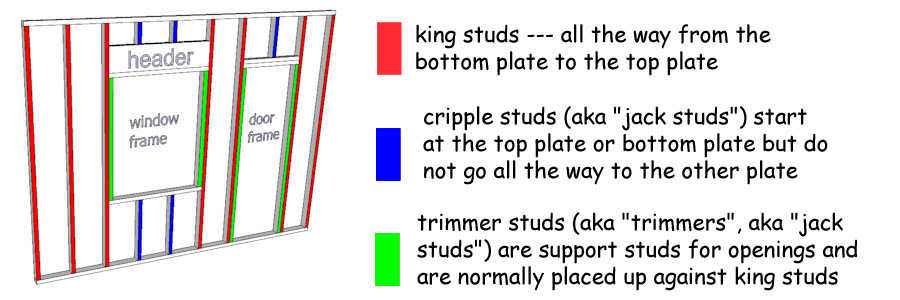
top plate --- see plate

torn grain --- A mechanical defect in which wood fibers below the level of the dressed surface are torn by a planer.

torque --- A force applied to cause rotation. Torque is measured as an equivalent straight line force multiplied by the distance (the "moment arm") and is given in units of foot-pounds of force. That is, if you apply a force of 15 pounds at the end of a wrench that is 2 feet long, the resulting torque is 2 feet x 15 pounds, or 30 foot-pounds (engineers prefer the more technically accurate term "pound-feet"). In woodworking, you apply torque when you turn a screwdriver, for example, and the amount of rotational force that a motor applies to a rotating shaft is also torque. There are special wrenches, called torque wrenches, that show the amount of torque so you can limit the torque to a specified amount so as to avoid breaking off the head of a bolt, for example, or tighten something to an amount that will allow it to be untightened without having to bring in a weight-lifter to do it.

torque wrench --- (1) A wrench that shows the amount of torque that is being applied, so that you can tell when you have tightened something to a given amount of torque.
torque wrench --- (2) A wrench that has an internal slip mechanism that can be set to a specified torque and then the wrench will not tighten beyond that torque, but will simply slip and click.

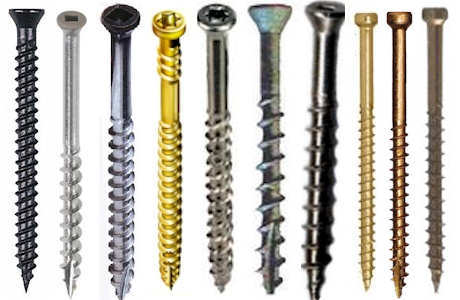
torx head --- A screw head requiring a driver in the shape of a star.

total span --- The horizontal distance between the supports of a load bearing member, measured from outside edge to outside edge. Compare/contrast to clear span.

touch sanding --- A form of wide belt sanding Used on the outer ply of plywood panels during manufacture to deal with irregularities due to patching, plugging or filling and to assure uniform thickness of panels.

touch up --- To repair misses, mars, scratches and places where a finishing agent has deteriorated or been damaged, in order to restore the finish.

toughness --- [same discussion given with hardness] Hardness and toughness are terms that have many, sometimes conflicting, characteristics depending on what definition you read, so take what I have here with a small grain of salt. Hardness is primarily the ability to resist deformation due to pressure. A hard surface is little affected by a sharp blow with a hammer but may be seriously scratched if rubbed by sandpaper. Some steels are good examples of this combination of characteristics. Toughness is primarily the ability to resist surface abrasion, so you could have a material that can be fairly easily deformed by pressure (and may or may not spring back to the non-deformed shape) yet which totally resists scratching. Some plastics have this combination of characteristics. In wood, toughness and hardness are fairly strongly related so it would be unusual to find a wood that is one but not the other. Durability in wood is primarily a function of toughness, but since hardness and toughness are strongly related in wood, harder woods tend to be more tough and thus more durable (in the mechanical sense; decay resistance is a separate issue). For wood, hardness is measured by the Janka scale; I am not aware of any scale for toughness in wood. Toughness also means the ability to withstand repeated blows or flexes without breaking. Leather, for example, is often quite tough but not hard at all.

toxicity --- The degree, and kind, of detrimental effect(s) caused by wood dust and more rarely by the wood itself or the leaves. There are three kinds of problems; skin, eye, and lungs. Some woods cause only one or two of these, some cause all three. Most woods cause none, but the problems can be severe in some people and they are sometimes cumulative. For example some people who develop a skin rash due to cocobolo dust become sensitized so that the next time they encounter cocobolo dust, the problem is worse. I have personally experienced all three kinds of problems from cocobolo dust, but I have not become sensitized. I wear a respirator when cutting any wood but I don't wear short sleeves. If you are new to exotics you should exercise caution. I can say from personal experience that the problems can be very unpleasant. My eye problem with cocobolo was so severe I had to go to the emergency room. Here is a list of woods and the potential issues they may cause: toxicity.

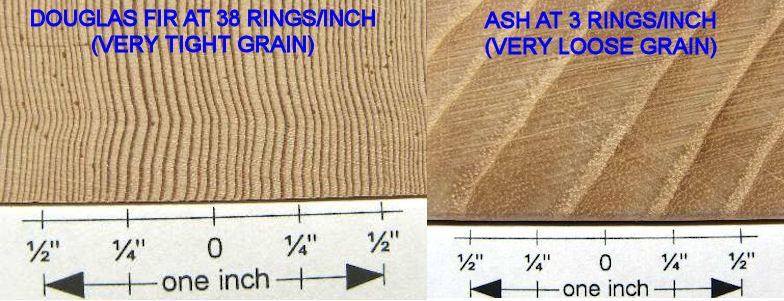
TPI --- Threads Per Inch; a measure of the density of threads on a screw or bolt.

tracheids --- Long tube-like water-carrying cells in softwood trees and some hardwood trees. In addition to carrying water, they also act as part of the support structure of trees. In softwoods, the tracheids are the bulk of the water-carrying elements AND the bulk of the structural support of the tree and generally make up 90% to 95% of the volume in softwoods. In hardwoods, where the water carrying tubes are called vessels, the tracheids range from much more sparse to non-existent depending on the species. In softwoods, the diameter of the tracheids is the primary determinant for the texture of the wood, with redwood for example having very large tracheids and being coarse textured and Eastern redcedar having very small tracheids and being fine textured.

trade name --- A name that is agreed upon by many, or even all, of the vendors who sell a particular wood species. It is intended to overcome the problem that most woods have many different common names. It is not fully universal so some wood dealers are quite willing to throw several similar species into one group and sell them all under the same trade name. For a more detailed discussion of the types of wood names, click here: wood names.

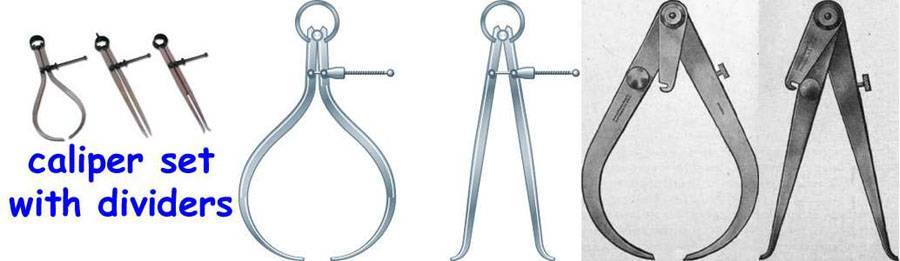
transfer calipers --- This form of calipers is just dividers but with the tips of the legs splayed either inward ("outside calipers" to measure outside dimensions such as the thickness of a bowl wall or the circumference of a spindle) or outward ("inside calipers" to measure inside dimensions such as the width of a channel in wood). In fact, transfer calipers are so similar to dividers that it is quite common to find a set of 3 items all sold together as a set: inside transfer calipers, outside transfer calipers, and a pair of dividers. Usually the legs of the outside calipers are curved instead of straight so that the calipers can be closed around something that is bigger at one point than the part that is to be measured. Such calipers with particular widely curved legs are also called "balloon calipers". Transfer calipers have no intrinsic measurement capability but rather are used to transfer a distance from an object over to a ruler; thus the name "transfer" calipers. Because they normally have some way of locking in the measurement so that it is not lost and does not becomes inaccurate while being transferred, these calipers are also called "locking" calipers. Examples:


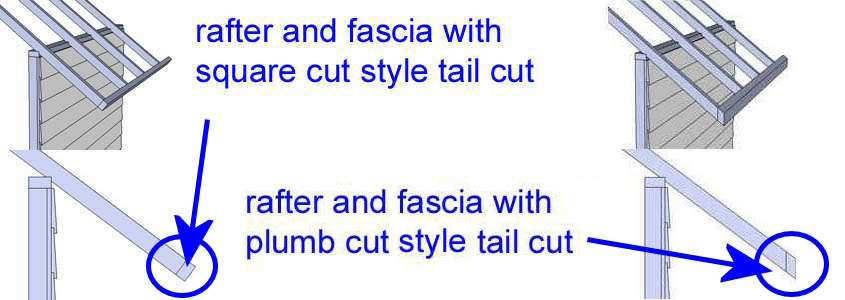
transition --- The area where two different roof planes come together. The ends of rafters at transitions usually require compound miter cuts.

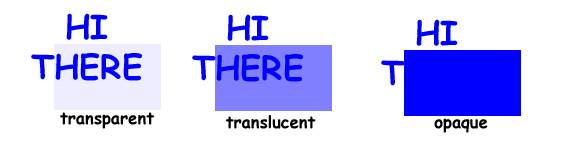
translucent --- Describes material that allows some light to pass through but which is not clear enough to see through. Compare/contrast to transparent and opaque. Examples:


transom --- (1) When there is a small window above a door, usually longer than it is high and opening by having the top or bottom fold inwards or outwards (as opposed to having a side move, as is common with some windows), then both that window and the structural area between it and the door are called the transom, although most usage refers to the window as the transom, not the horizontal structural member under it.
transom --- (2) A horizontal bar within a window, usually a glazing bar but it would still be called a transom even if it were just decorative and sitting on the surface of a larger glass sheet.

transparency --- The extent to which a material allows light to pass through. Compare/contrast to opacity.

transparent --- Describes material that allows light to pass through completely; clear enough to see through. Compare/contrast to translucent and opaque. Examples:


transverse --- (1) As regards woodworking, this term is used to describe any plane or flat surface that is perpendicular to the axis of the tree. For example, the upper surface of a stump that has been cut off parallel to the ground is a transverse surface. The other two planes of trees that are used to discuss a number of issues regarding wood are the radial plane and the tangential plane. When talking about all three planes together, the tangential and radial planes are always considered to be perpendicular to each other, with the transverse plane perpendicular to both of them.
transverse --- (2) Across. A transverse beam is one that goes across the length of a building or room rather than along the length. Contrast to longitudinal.

transverse load --- A force applied perpendicular to the plane of the longitudinal axis of a member. For example, if a plank were laid across a puddle and supported only on the ends, then someone standing in the middle of the plank would be exerting a transverse downward load on the plank.

tread --- The horizontal part of a stair step; the part that is stepped (tread) on. The tread is normally supported by a stringer.

tree --- What is a tree and what is a shrub? There's no really clear-cut definition that will satisfy everyone in all cases, but the American Forestry Association of the USDA has the following definition: a woody plant having one erect perennial stem or trunk at least 9.5 inches in circumference (3 inches in diameter) at 4.5 feet above the ground (DBH), a definitely formed crown of foliage, and a height of at least 13 feet.

tree farm --- A privately owned forest managed for profit.

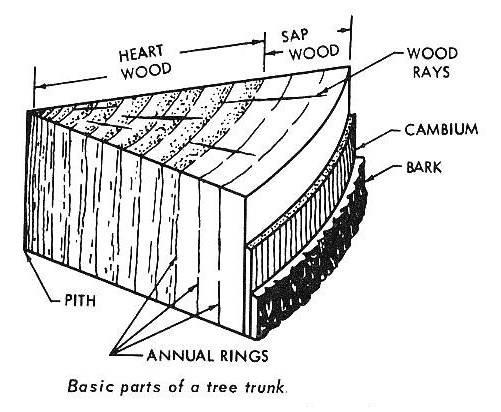
tree growth --- Since this is a glossary and not a textbook, the focus here is on a tree more than a couple of years old and does not start with the seed. In such a tree, there is the pith at the very heart (vertical axis) of the tree, then heartwood (which is sapwood that has died and undergone various changes), then sapwood (live cells that carry water up into the branches and leaves), then the cambium which is the one-cell thick layer that constantly divides itself during the growing season and creates both sapwood and bark, and then the bark itself, which is the outer, protective, layer of the tree. Bark has an inner, live, section called the phloem next to the cambium and a dead, outer, section. The sap in a tree is carried down from the leaves by the phloem. Among other things, the inside of the tree contains medullary rays which transport nutrients horizontally; these are labeled "wood rays" in the image below. During the course of a year, trees in all but the temperate zones of the world have a spurt of growth in the spring and early summer, called early growth (or spring growth), followed by slower growth in the late summer and early fall, called late growth (or summer growth) which together form one of the annual rings.


tree trunk --- see trunk

trencher --- A wooden plate used at the table. Derived from the French word tranchier (to cut), the term referred in medieval times to a piece of stale bread that was cut into a flat square and used as a plate; this was more recently replaced by a rough wooden plate, still called a trencher. The phrase "hearty trencherman" means a person who eats a substantial amount; someone with a healthy appetite for food. Trencherman can also be synonymous with glutton.

T rest --- see tool rest

trestle --- (1) A bridge support structure consisting of a rigid frame of braced support beams under the bridge.
trestle --- (2) A pair of saw horses used to support a large workpiece. Sometimes the term is reversed and a single sawhorse is called a pair of trestles, but that is really a less appropriate description.
trestle --- (3) A type of table where there are strong support structures at each end, usually "H" shaped, connected across the length of the table by a hefty beam. This is a very strong table.

trim --- (1) The finishing materials in a building, such as moldings, applied around openings (window trim, door trim) or at the floor and ceiling of rooms (baseboard, shoemold, cornice, and other moldings).

trim --- (2) Small decorative strips of wood on furniture, such as a carved face frame on a cabinet) or an intricate molding at the top of a clock case.

triple lap joint --- synonymous with three way lap joint

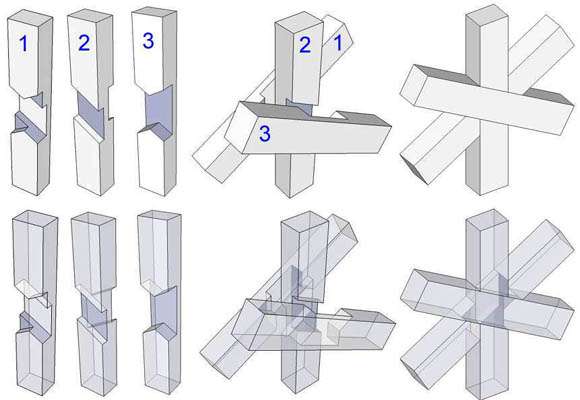
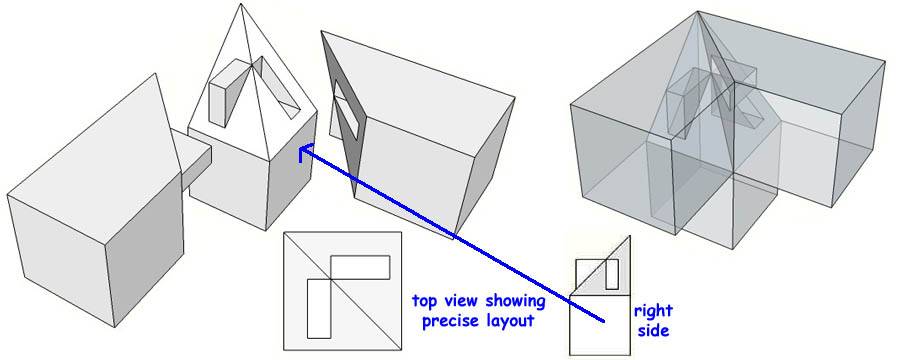
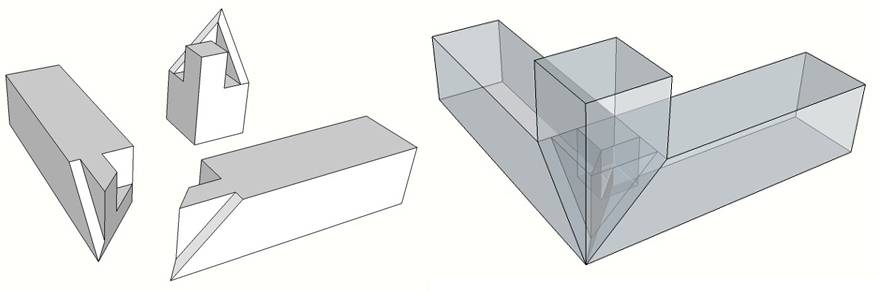
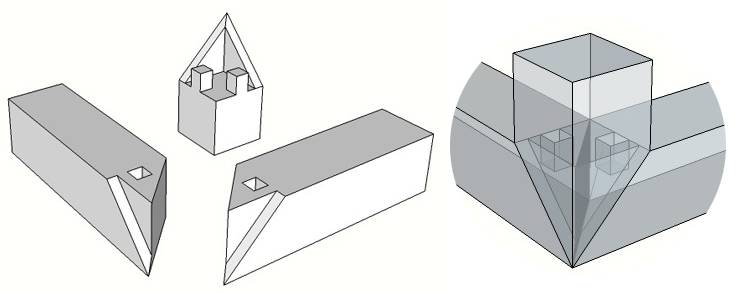
triple miter joint --- I have seen several joints called triple miter joints. What they all have in common is that their purpose is to joint three square cross section pieces all at right angles to each other (like the "XYZ" of 3D coordinates).

The first one shown below is my favorite, but only because of looks. I've never build one but I have to believe that it quite a challenge. Note that all three of the square rods of wood are cut to exactly the same shape before the three are joined. You might have to mull this one around in your head for a minute or two (I did) before you are convinced that it actually works that way. The complexity of the joint pays off in the strength it creates --- the joint is reinforced by the square tenons in all directions except for pulling any member directly out of the joint along its length, and of course there's a lot of glue surface area because of the mortise and tenon arrangement.

The other two are also complex and do not have the same cuts on all three pieces. These joints are also generally included in Japanese joints. Examples:


tripoli --- synonymous with rottenstone

tropical --- As regards wood, this refers to climate, specifically meaning a climate that has only very mildly varying, even unchanging, seasons or summer and winter. The tropical zones of the world are from the equator to 30 degrees of latitude in both hemispheres. Above that, up to 60 degrees latitude, are the temperate zones, and above 60 degrees are the polar zones. HOWEVER, there are some portions of the tropical zones that have temperate climates, so you can't entirely rely on geography to tell you if a wood has grown in a temperate climate. Trees that grow in temperate climates have growth rings where as trees that grow in those tropical climates that have a wet growing season year-round tend to not have growth rings, but trees that grow in tropical zones that have at least a somewhat temperate climate do have growth rings, though likely somewhat weak ones.

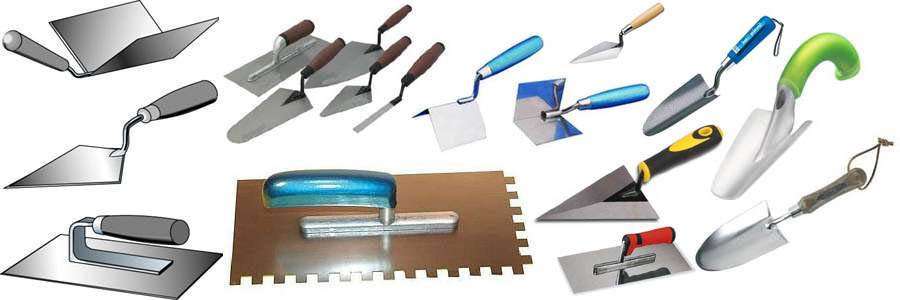
trowel --- (1) One of several similar hand tools used for digging, smoothing, or otherwise moving around small amounts of high viscosity materials such as concrete, mortar, or plaster. Trowels come in various sizes and shapes and with smooth or ridged edges depending on the application. Since these are not primarily woodworking tools, I do not plan on any extended discussion in this glossary.
trowel --- (2) A small hand tool used in gardening for digging up small amount of soil.

Examples of both types:


trunk --- (1) That main portion of a tree that begins a little above the ground and continues up almost to the top, where it becomes the crown. The trunk is the portion of the tree that, once cut from the stump and stripped of branches, becomes a log from which lumber is produced. That part of the trunk that is most commercially useful, from the bottom up to the first branch, is called the bole.
trunk --- (2) A large rectangular container, sometimes made from wood, generally for storing clothes. In earlier days, this served the purpose of a very large suitcase. A "sea chest" is one form of trunk and was made with a curved top using barrel staves.

trunnion --- Most often seen in reference to cannons and drawbridges, this term refers to a pair of cylindrical projections on something and that ride in a corresponding pair of arced supports. It's a way of supporting an object that rotates through less than a full circle and that does not have a full axle, just the projecting cylinders on each side. In woodworking the term is most often used in regards to the support system for the motor in a table saw. In fact, it is the mounting of the trunnions that partially defines the difference among types of table saws.

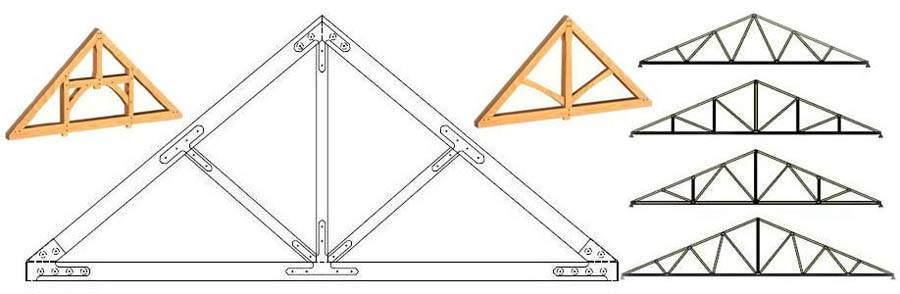
truss --- A framework of beams forming a rigid construction that supports a roof or bridge or other structure. In its simplest form a truss is much like a pair of rafters but with a zig-zag set of other supporting members that allow for structural rigidity across a wider span than would be supportable by just rafters alone. Trusses are designed to support loads over a span with the truss being supported only at the end point. The places where the zig-zag members meet are called nodes, and they may be further supported by gussets. Examples:


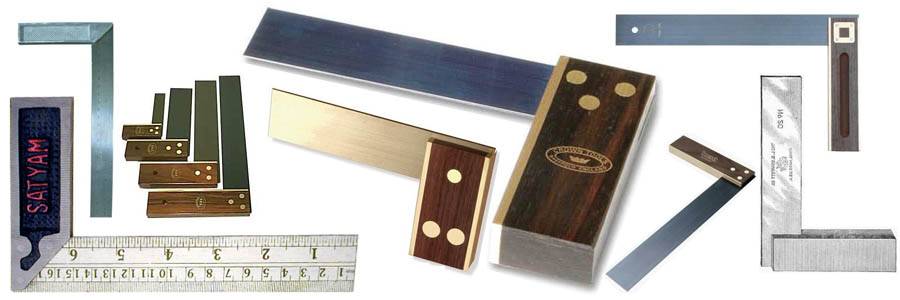
try square --- A measuring and marking device that consists of a flat metal rectangle, usually quite a bit longer than the width, attached to another piece that is at right angles to it. The flat metal rectangle may or may not be marked with ruler markings. Typically, the second leg is made of wood and is much thicker than the metal leg, and is set at a very precise 90 degrees to it. Fancy try squares come with the large leg made of rosewood with brass inserts but their 90 degrees isn't any better than cheaper ones. In the interest of full disclosure, however, I have to admit that I bought one of the fancy ones, not because I believe it will measure any better than a cheap one but just because it LOOKS so damned nice. Compare/contrast to steel square. Examples:


T slot --- A slot milled in the shape of an upside down letter "T" to hold special bolts for clamps or jigs. There are router bits specifically designed to cut T slots.

tub grinder --- A pair of very large concentric "tubs" (think large pot) that are fairly close to each other with the inner one rotating and thus crushing any material put between the two. Used in various industries including wood processing. Compare/contrast to hammer mill, mill chipper, and whole tree chipper.

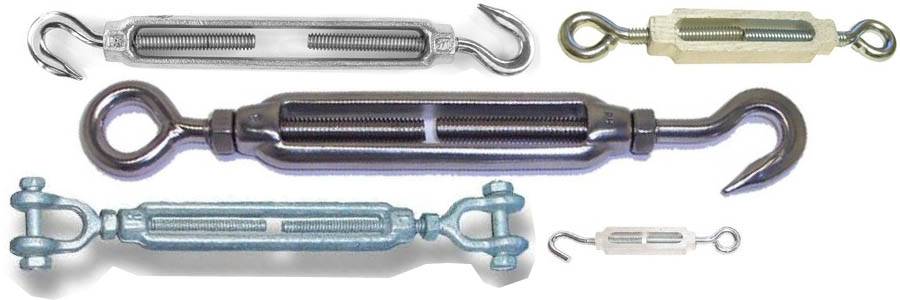
turnbuckle --- A device for tensioning cables, ropes, tie-rods, etc. It consists of a metal centerpiece with threaded holes in each end, one left-hand thread, one right-hand thread, into which are screwed eyelets or hooks. When the center piece is turned, both eyelets are moved in or out simultaneously, thus increasing or decreasing the tension on whatever is hooked to them. In large uses, you'll see them in guy wires on telephone poles, the rigging on sailing ships, etc. Examples:


turning --- [verb] Creating an object on a lathe; using a lathe.
turning --- [noun] An object created on a lathe

turning blank --- see blank

turning gouge --- synonymous with lathe gouge

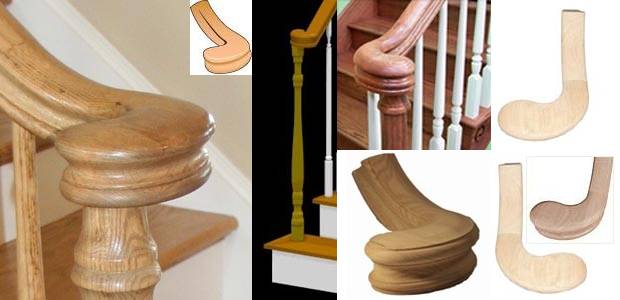
turnout --- A term that has many meanings in English, but as regards woodworking, it refers to a quarter turn end to a staircase handrail; a truncated, or partial, volute. Examples:


tusked --- see tusked mortise and tenon

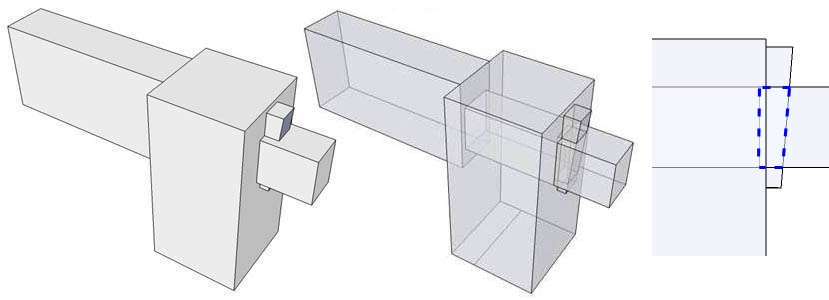
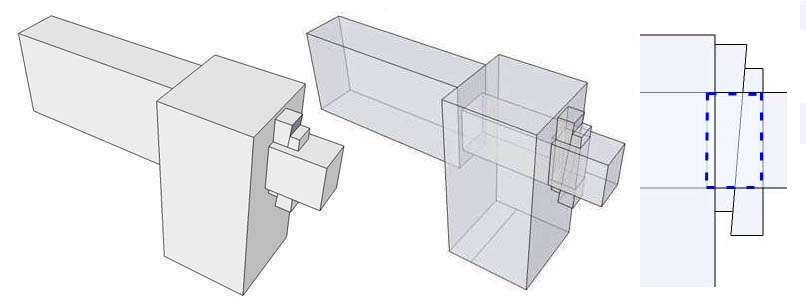
tusked mortise and tenon --- A mortise and tenon joint where the tenon is extra long and sticks out well past the opposite face of the mating board, and has a channel cut in it to accept a wedge which is used to both draw the joint tight (no glue, nails, dowels, or screws are used) and also to allow for easy disassembly of the joint (it is a knockdown joint. Note that the outer edge of the wedge cutout is angled at the same angle as that of the wedge so that the wedge exerts a uniformly distributed force on that surface. Folding tables make good use of this technique. There are a couple of types of this joint, depending on the number of wedges (one or two) and the orientation of the wedge cutout (horizontal or vertical). Also called "wedged", "pegged", and "pinned" mortise and tenon. Examples:


tusked mortise and tenon with folding wedges --- A type of tusked mortise and tenon where the wedge mortise is not angled on its outer surface but rather it is straight up and down and the wedging is done with a pair of wedges (folding wedges). Example:

need to add tusked mortise and tenon with folding wedges pics


twig --- A small, leafless branch that is growing out of another branch on a flowering plant. Technically, a really small branch growing directly from the trunk of a tree is a branch, not a twig, but in common usage, it might well be called a twig. Also, I don't think most people make the distinction between a small branch that has a leaf and one that doesn't.

twin bridle joint --- Just like a standard bridle joint except that there are two prongs instead of one. As can be seen in the examples below, the joint can be half blind or through.


twin mortise and tenon --- Any of the many mortise and tenon joints but distinguished by the fact that it has two tenons instead of just one. The two tenons can be side by side or over/under each other, and the joint can be stubbed (blind) or through, haunched or not, and so forth. Examples:


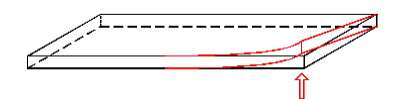
twist --- The Twist is a 1950's dance craze ... no wait ... sorry, it's a spiral distortion along the length of a piece of timber where at least one end moves away from the plane of the plank. This is generally a drying defect. The picture below shows a simple one-corner example, but in a severe case, all four corners of the plank would move in the kind of directions that you get when you twist a towel to squeeze water out of it. The black image below shows the flat plank and the red lines show one corner's twist with a red arrow showing the direction of the twist. A more extreme example is shown in the drawings that accompany the term warp (twist is a type of warp).


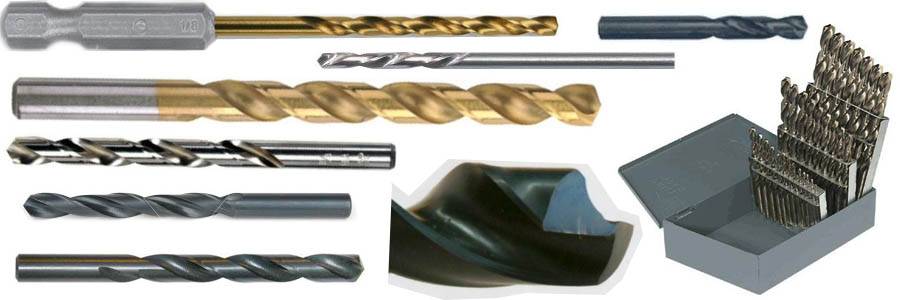
twist drill bit --- This is the "normal" drill bit, the one that folks are probably thinking of when they say "drill bit". It is a long metal shaft with helical fluted cutting edges and a fairly broad point. These bits are good for both wood and softer metals. In the USA, these drills can be purchased individually by size and also come in numerous sets. The most common sets are the "A to Z" set (A=.234", Z=.413"), the "#1 to #60 set (#1=.228", #60=.040"), and the "1/64 to 1/2" in 1/64" increments set. There is also a lesser known set of micro bits #61 to #80 (#61=.039", #80=.0135") and there are variations on the "normal" twist bit, including the very popular brad point bits. Examples:


two by four --- [also 2x4] A piece of dimension lumber that has a nominal size of 2" x 4" (and an actual size of 1 1/2" x 3 1/2"). This is the most common of sizes in dimension lumber and is the basic construction lumber of most wooden-frame buildings including houses.

two jaw chuck --- A chuck with two jaws; very rarely used, I believe. Example:


two ply veneer --- A decorative wood veneer face with a utility grade wood backer applied at an opposing direction to the face veneer to provide strength and inhibit splitting. Also referred to as "wood on wood".

tyloses --- A waterproof, foam-like substance that forms in the pores of some species of wood and blocks them, thus impeding or even totally preventing the movement of moisture through the pores. It is an extension of parenchyma cells. It is common in white oak and makes that wood excellent for barrels to hold liquids (tight cooperage) because in the case of white oak, the tyloses completely close the pores and make the wood impermeable even though it is porous. When wood is examined in transverse section, tyloses usually glistens. Woods high in tyloses dry very slowly and are difficult to treat with preservatives for outdoor use.


for images of wood itself, go here -> wood id site

A    B    C    DE    F    GH    IJK    L    M    NO    P    QR    S    T    UVWXYZ   
To see general comments about this glossary and for the email address, click here: GLOSSARY